No one
lied to you
Thirty-six ways a diamond buyer loses money. Only eight are unlawful in most places.
Thirty-six ways money is lost buying a diamond, a coloured gem, or a finished piece, each with the way to spot it and what to do instead. Nine checks you can run yourself, in the order that saves you the most first. Written by a graduate gemologist who has priced stones on both sides of the counter for twenty-five years, and who sells none, so the only person paying me is you.
$150 for the book · $450 to have me read your stone and quotes before you buy
Most of the money a buyer loses is lost legally, and quietly, across a counter where only one side knows what things really cost.
Buying a diamond is one of the few big purchases people make while their feelings are running high, with no training and nobody to ask, across a counter from someone who prices stones for a living. Nobody has to lie. The paperwork can be correct. The stone can be exactly what the report says. And the money still goes.
Of the thirty-six ways it goes, only eight involve anyone actually lying to you, and those are rare in a proper shop. They happen in tourist markets, in private sales, and in listings nobody has checked. The rest is about what is never mentioned, and what you had no way of checking. That is the part this book is for.
Read it once before you go shopping, and take the one-page checklist into the shop with you. That is all it asks of you.
Everything else you've read was paid for by the people selling the diamond.
The free advice is free for a reason. The review sites earn a commission on the stone you click through to buy. The concierge who helps you for nothing is paid by the shop when you say yes. Even the honest jeweller's guidance runs out exactly where his margin begins.
None of them are lying. That is the whole point of the title. They simply aren't working for you.
I sell no stones, and I take no commission from anyone who does. The only person who pays me is you, which is the only reason I can tell you the twenty-eight things nobody with a stone to sell ever will.
Eight are unlawful. Twenty-eight are not.
Every one of the thirty-six is marked as one of these three, because which one it is decides what you can do about it.
Someone tells you something untrue, or hides something from you. Unlawful in most places.
Rare in a proper shop. It happens in tourist markets, in private sales, and in online listings nobody has checked.
Nothing untrue is said. You are misled by what nobody bothers to mention.
Common, and this is where most people lose real money.
Completely legal. You pay more than you needed to, because you cannot see what the stone is worth.
This happens to almost everyone. Nearly every buyer in a shop pays some of it.
Ten sections, in the order you'll need them
Not a survey of diamonds. A route through the exact decisions you'll face, in the order you'll face them.
Diamonds in Ninety Seconds
The six words the whole trade assumes you already know, the parts of a stone, and where your money actually goes between the mine and the price tag. If you know them already, skip it. The book says so itself.
The Document
A grading report explained one part at a time: the grades, the diagram of the stone's proportions, the measurements, the line about glowing under UV, the map of its internal marks, the laboratory and the date, the engraved number and the comments. Then the part that matters most, which is what the report does not tell you.
How Money Is Lost
All thirty-six ways money is lost, grouped by where they catch you: the paperwork, the stone, the price, the sale itself, and afterwards. Each one tells you how it works, what it costs you, how to spot it, and what to say or do instead.
The Nine Instruments
The nine things you can check yourself, in the order that removes the biggest risks first, starting with the ones that cost nothing. They come in three groups. First the paperwork: who graded the stone, whether the report is real, and whether the number on the stone matches it. Then the stone itself. Then the price. Each one also has a version for buying online.
The Encounter
What to say and in what order, starting with the first minute in the shop. How to negotiate the whole package instead of haggling over one figure, and where there is genuinely room to move on price and where there is none. Then buying abroad in the big trading cities such as Dubai, Antwerp, Hong Kong, Mumbai and New York, with a longer piece on buying in the Gulf.
The Setting, the Metal, and the Box
The ring around the stone is really three costs in one: the metal, the jeweller's time, and the small stones set around the main one, which are almost never graded or priced separately. Platinum against white gold, which is not actually white. It is yellow gold with a pale coating that wears off, so it has to be redone every year or two, and nobody mentions that at the counter. How the setting can cover the edge of the stone and hide the number engraved on it. What the box and packaging are worth when you come to sell. And how having the ring resized can quietly end your right to return it.
After the Money Moves
How to insure it properly, and what the different policies really pay out. The record to put together in the first month, and where to keep it. Wearing it, storing it, looking after it. What you can still do if you have already bought. And what you would honestly get back if you sold it.
Reference
Forty-two words explained in plain English. The laboratories and how they differ. Three tables you can check a stone against: proportions for round stones, how wide a stone should look for its weight, and the best shapes and ratios for every other cut, including the rule nobody mentions. How the trade sets prices, on one page. And an index of all thirty-six.
Beyond the Diamond
Coloured diamonds, rare stones, and coloured gems such as ruby, sapphire and emerald, covering the last seven of the thirty-six. Here there is no price list at all. Prices come from what similar stones have sold for, you need your own expert rather than the seller's, and you work out what you could sell it for before you buy. The section is about knowing when you have reached that point.
When More Is at Stake
For the largest purchases: the one-page mandate to hand whoever buys on your behalf, how provenance and a name become part of the price, estate and succession, and the point at which you should bring in an independent, non-transacting expert.
Fifteen illustrations, because some of this is easier to see than to explain
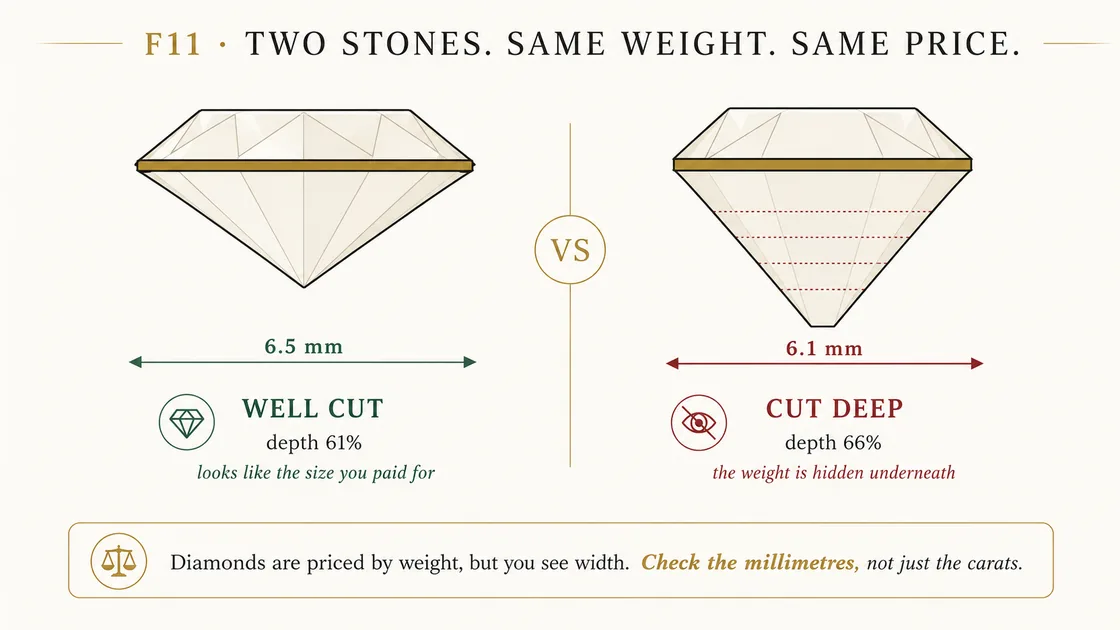
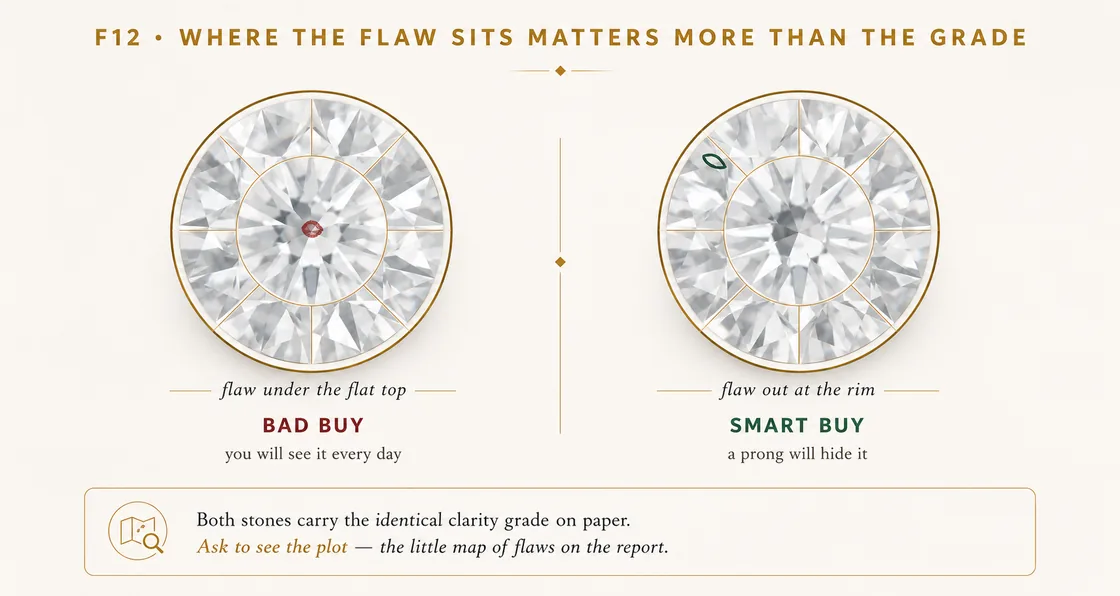
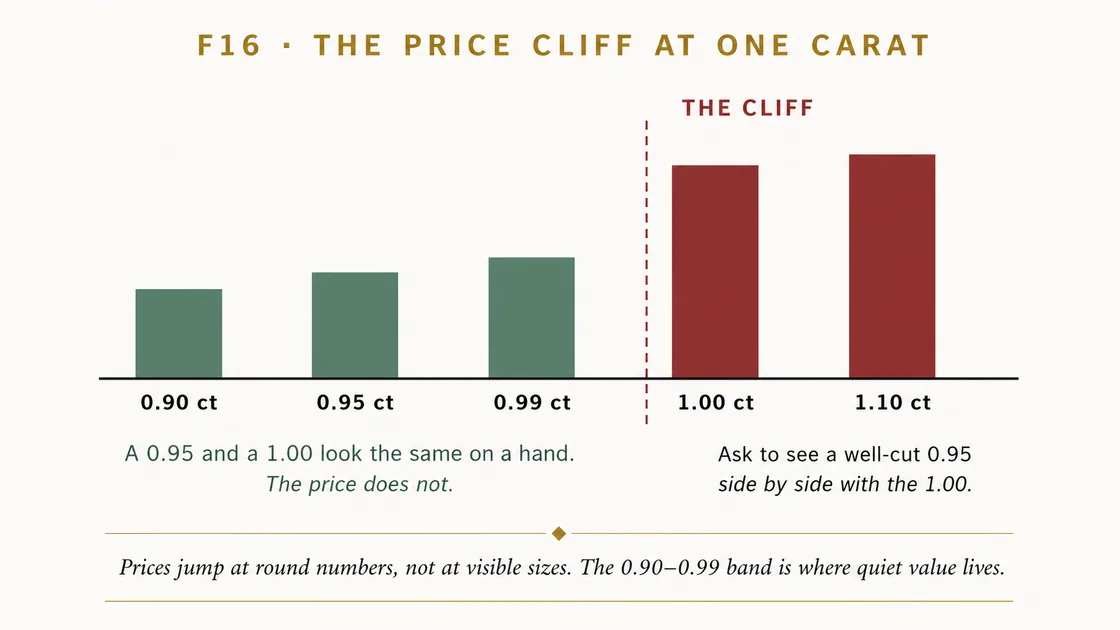
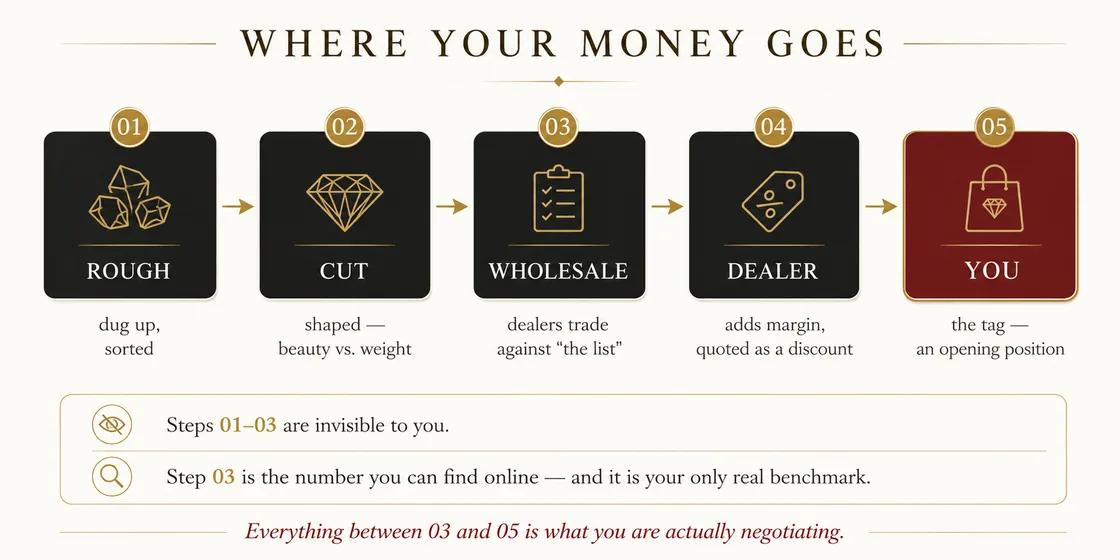
You are told the book is good. Here is one of the thirty-six, worked start to finish, so you can judge for yourself.
The trap. Two round diamonds, the same carat weight, the same price. One looks a size bigger across the table. You are paying for weight the setting hides underneath, not for the size your eye actually sees.
How to spot it. Ignore the carats for a moment and ask for the millimetre width. A well-cut one-carat round measures about 6.5 mm across; a deep-cut one can measure 6.1 and bury the rest of its weight in depth you will never see.
What to say. Ask what the millimetre spread is, and how it compares to a well-cut stone at this weight. A shop that answers in a sentence is worth staying in. One that cannot has just told you something.
That is one of thirty-six. The book runs the same three steps on every one of them.
The End of the Secret
For a hundred years this trade rested on two controls: control of supply, and control of information. Both are gone. Not weakening. Gone.
The last chapter, free and in full, with nothing attached. It is the argument the rest of the book is built on, and the least useful page in it if you are standing in a shop this afternoon.
Read the essayBefore you buy the book
Why does this cost anything when the diamond advice online is free?
Because the free advice is paid for by whoever is selling you the stone. The review sites earn a commission on the diamond you click through to buy; the free concierge is paid by the shop; the jeweller's help ends where his margin begins. I sell nothing and take no commission from anyone who does. You are the only one paying me, so I am the only one working for you.
I already bought. Is it too late?
Usually not. There is a whole section on what to do after you have bought. It shows you how to find out what you actually own, how to read your receipt, which three deadlines you are working against, and who to go to if the shop will not help. How much you can do depends on what your paperwork says.
I'm buying online, not in a shop. Is this still for me?
Yes. Every photo and video you are shown online was lit by the seller, and the book counts that as one of the thirty-six ways money is lost. So the inspection you would have done in the shop moves to the moment the stone arrives, while you can still send it back, and the book tells you exactly what to check and in what order.
Is this about being ripped off?
Mostly not, and that is the reason it exists. Only eight of the thirty-six ways are unlawful, and those are rare in a proper shop. The other twenty-eight happen when nobody says anything false. The paperwork is correct, the stone is what it says it is, and you still pay more than you needed to, because there was no way for you to see what it was worth.
I know nothing about diamonds. Will I be lost?
No. The book starts by explaining the six words the trade assumes you already know. After that, every new word is explained as you meet it, and there is a plain version of each page that gives you the point in one line. You can read the whole thing in one sitting and come back for the detail later.
Do I need a loupe or any equipment?
No. The checks that protect you from the worst outcomes need nothing but the report, your phone, and asking to see the tiny number engraved on the stone. Two of the nine checks do need magnifying. For one you borrow the shop's microscope, and for the other a cheap 10x loupe is enough. The book is honest about what a loupe can and cannot show you.
Does it cover lab-grown diamonds?
Yes. A lab-grown diamond is a real diamond made in a factory, and it costs a fraction of a mined one. Being sold one as mined is the most expensive mistake in the market today, and nobody can see the difference by eye. Only the paperwork shows it. The book also covers buying one on purpose, the recent collapse in lab-grown prices, and why the discount you are offered on it is usually not a discount at all.
Does it cover coloured stones, like ruby, sapphire and emerald?
Yes. The last seven of the thirty-six ways money is lost are about colour, where the value scale runs backwards and one treated word on a report can move the price a hundredfold; ruby, sapphire and emerald get their own treatment as well. One warning though. It will not teach you how to price a sapphire, because for coloured stones there is no price list to work from. What it will do is tell you when you have gone past what the rest of the book can protect you from, and what to do instead.
Will it tell me what my stone is worth?
No. Anyone who gives you a figure without seeing the stone is not being straight with you. What the book does instead is show you how the trade works out its prices, so you can look up what a stone like yours sells for elsewhere before you talk money. It also tells you what you would really get back if you sold it.
Who are you, and can I trust someone across the world?
I am a GIA graduate gemologist with twenty-five years in the trade, working from Dubai, one of the world's diamond and coloured-gem hubs. You do not have to take that on faith: read the free chapter first, and the book is refundable for fourteen days whether you have opened it or not.
What if the book is not for me?
Then you tell me within fourteen days and I refund it, whether you have read it or not. The hour is refundable up until I start going through your paperwork. The risk is mine, not yours.
This is general information, not legal advice. Your rights and deadlines depend on where you are and how you paid.
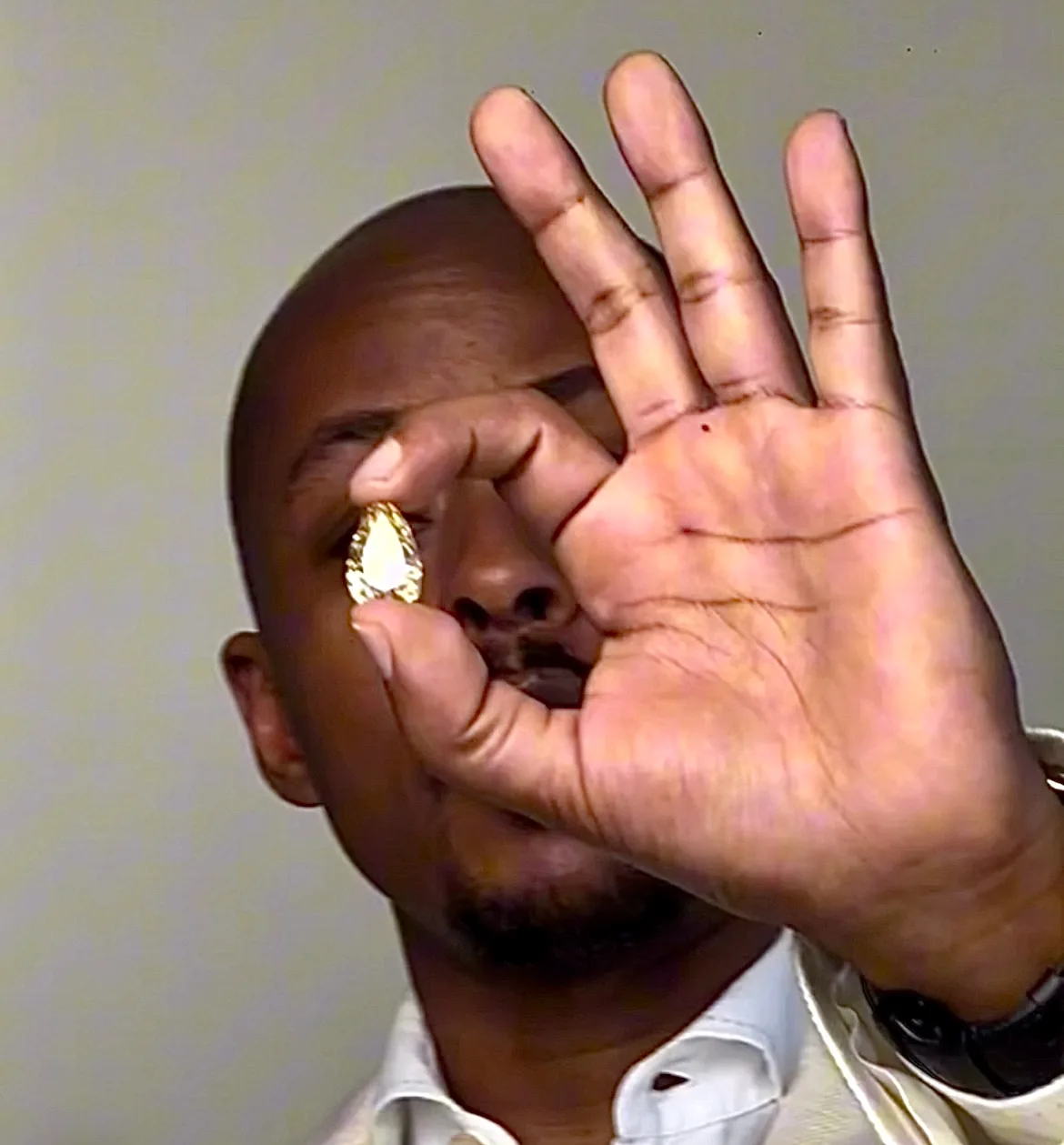
The industry profits from what you don’t know.
This book teaches you what to look for, what to question, and when to walk away.
The book, or the book and an expert in the room with you
The book
The whole field manual: thirty-six ways money is lost, one to a page, the nine checks you can run yourself, fifteen illustrations, forty-two terms in plain English, and the one-page checklist you take to the counter.
This is one of the biggest things you will ever buy, and nobody teaches you how. Read this first and you walk in knowing what to ask, in what order, and what a straight answer sounds like.
You read it on a screen, not in a PDF. It works on your phone, in the shop, with no signal, while someone is waiting for your answer.
One payment. Yours for good, including every later edition.
Read it the night before you go shopping. Open the checklist at the counter. That is what it was built for.
It is for the person buying one serious piece and wanting to get it right. If the shop cannot answer the questions in this book, you are in the wrong shop, and you will know it within a minute.
Read it in an evening. 14 days to change your mind, refunded whether you have read it or not, and you keep the book.
The book, and me on the call before you decide
The book, and an hour with someone who has done this for twenty-five years, before you spend the money instead of after.
Tell me what you are planning to buy. A diamond, a coloured gem, a finished piece of jewellery. Send me whatever you have so far: the reports, the prices you have been quoted, the photographs, the shops you are talking to. I go through all of it in my own time before we speak.
Then we get on a call and work through it properly. What you are really being asked to pay for. Which of the options in front of you is the better buy and why. What the paperwork is telling you and what it is leaving out. Where there is room to negotiate and where there is none. What I would do if it were my money. I explain the reasoning as we go, so you can carry it into the shop and use it without me.
Most people come out of the hour buying something different from what they walked in wanting, at a better price, and they stop second guessing it. That is the point. An hour now instead of weeks of research, and no expensive lesson learned afterwards.
You get my notes in writing afterwards. It is my opinion, not a valuation or a formal appraisal, and it is yours to use however you like.
The stakes: the average ring costs more than six thousand dollars, and plenty cost far more. This is the hour that keeps that decision from being the wrong one.
I take only four of these a month, so each gets the time it needs.
My opinion in writing, not a valuation. Refundable up until I start going through your paperwork.
{{ refundLine }}

Faiz Fikak
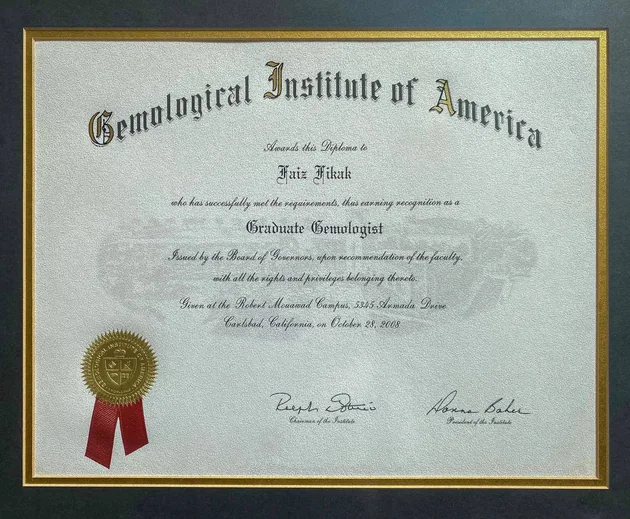
Graduate Gemologist, GIA. Twenty-five years in the trade, buying and pricing stones, on both sides of the counter. This is the book I would want my own family to read before walking into a shop.
First edition · Dubai · 2026
Read it before you shop
Over thirty-three thousand words. Thirty-six ways money is lost. Nine checks you can run yourself. Fifteen illustrations. Forty-two words explained.
{{ priceOne }} for the book · {{ priceTwo }} to talk it through with me first
14-day refund on the book. The hour refundable until I open your paperwork.